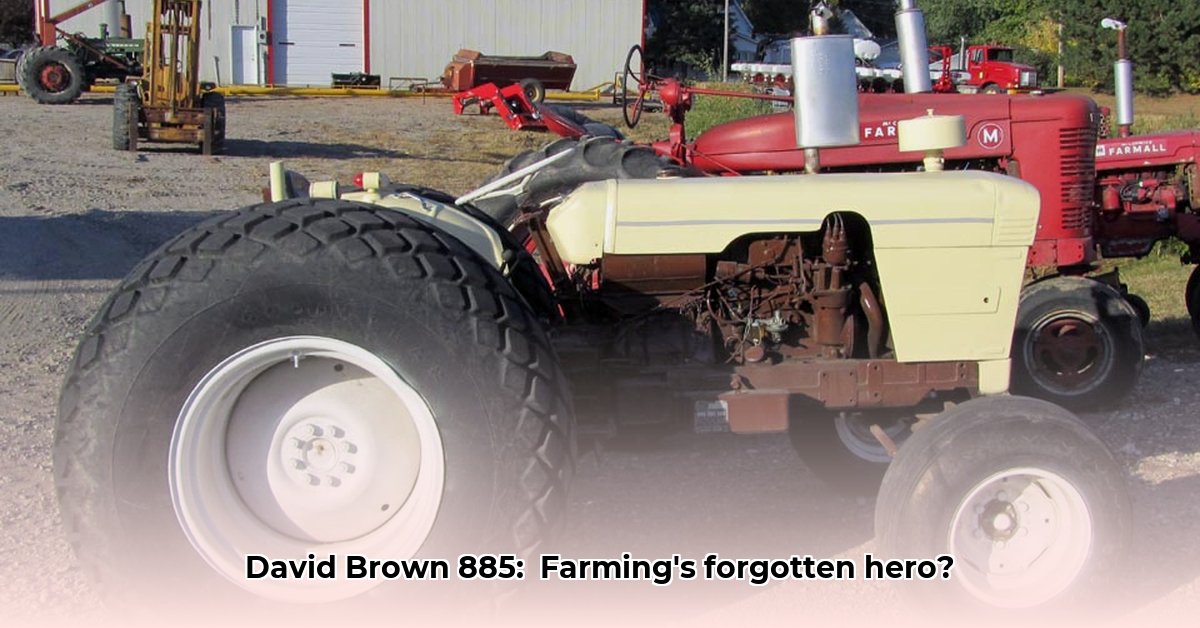
David Brown 885 Tractor: A Legacy of Durability and Sustainability
The David Brown 885 tractor, a stalwart of the 1970s agricultural landscape, offers a compelling case study in the intersection of vintage technology and sustainable farming practices. Produced from 1971 to 1980, this workhorse represents a simpler era of farming, emphasizing durability and straightforward design over complex electronics. This article explores its technical specifications, historical context, and surprising relevance to modern sustainable agriculture. For more information on David Brown tractors, see this helpful website.
Technical Specifications and Historical Overview
The David Brown 885 typically boasted a diesel engine generating approximately 47 horsepower, sufficient for a range of farm tasks. Its 12-speed, partially synchronized transmission provided the flexibility needed for diverse field conditions. While sources vary on precise figures (likely due to options and modifications over the production years), the tractor's hydraulic system played a crucial role in its operational capabilities. The reported weight varies between approximately 1934 kg and 2450 kg, again reflecting the aforementioned variability. This disparity highlights the challenges inherent in researching older machinery, where precise specifications can be elusive. The 885 was primarily a two-wheel-drive tractor, well-suited to smaller farms and specialized operations. It was not designed for large-scale industrial farming, but its simplicity and reliability made it a dependable workhorse. Isn't it fascinating how such seemingly minor variations in weight or horsepower can tell us so much about the realities of production and use?
The 885's emergence coincided with a pivotal period in agricultural history: the 1970s witnessed a growing emphasis on efficiency and mechanization. Yet, the 885 represents a more modest, less complex approach compared to the increasingly sophisticated machinery that was quickly becoming the norm. Its design reflected both the technological advancements of the time and the practical needs of smaller farming operations.
Sustainability Aspects: A Different Kind of Green
The 885's sustainability profile is complex. While its fuel efficiency may fall short of modern standards, and it exclusively used fossil fuels (diesel), its design fostered a unique form of sustainability. Its relatively uncomplicated mechanics made maintenance and repairs significantly easier compared to modern tractors. Although finding replacement parts can be challenging, the simple design often allows for inventive repairs and adaptation. This inherent repairability dramatically extends the tractor's lifespan, reducing the environmental impact related to frequent replacements. Many 885s remain operational today, showcasing the durable nature of its construction. This longevity contrasts sharply with the "planned obsolescence" frequently associated with contemporary technology. This enduring quality highlights a type of built-in sustainability. How can we re-evaluate our notions of sustainability in light of such long-lasting machinery?
Modern Relevance: Beyond the Barn
The David Brown 885 is far from a museum piece. Interest in these tractors has seen a resurgence among various groups. Restoration enthusiasts appreciate the challenge of bringing these classic machines back to life, while collectors value them as tangible pieces of agricultural history. Furthermore, some small-scale or hobby farmers still use 885s for specific tasks, demonstrating their enduring practicality. This enduring appeal underscores the machine’s inherent quality and robust build. Many find the tractor to be symbolic of a simpler time, representing a more deliberate approach to farming.
Actionable Insights for Stakeholders
To preserve and further the legacy of the David Brown 885, different stakeholders can take proactive steps:
- Agricultural Historians: Document operational data (fuel consumption, maintenance) and conduct comparative life-cycle analyses against modern machinery.
- Restoration Enthusiasts: Create online resource hubs to facilitate parts sourcing and develop shared repair manuals.
- Sustainable Farming Advocates: Analyze resource efficiency relative to modern tractors and explore the feasibility of biodiesel conversion.
- Agricultural Engineers: Evaluate the design for potential efficiency improvements and develop broader frameworks for assessing the environmental impact of farm equipment.
Conclusion: A Timeless Lesson in Sustainability
The David Brown 885 stands as a potent reminder of the evolving relationship between technological progress and sustainable agricultural practices. Its straightforward design, remarkable longevity, and adaptability suggest that simplicity and durability remain valuable assets in achieving sustainability goals. By studying its strengths and weaknesses, we gain valuable insights that can inform future agricultural technology and encourage a more mindful approach to farming. The 885's legacy extends beyond its function as a tractor; it serves as a powerful symbol of the enduring importance of robust, repairable machinery in the pursuit of sustainable agriculture.